
Portraits From the Past

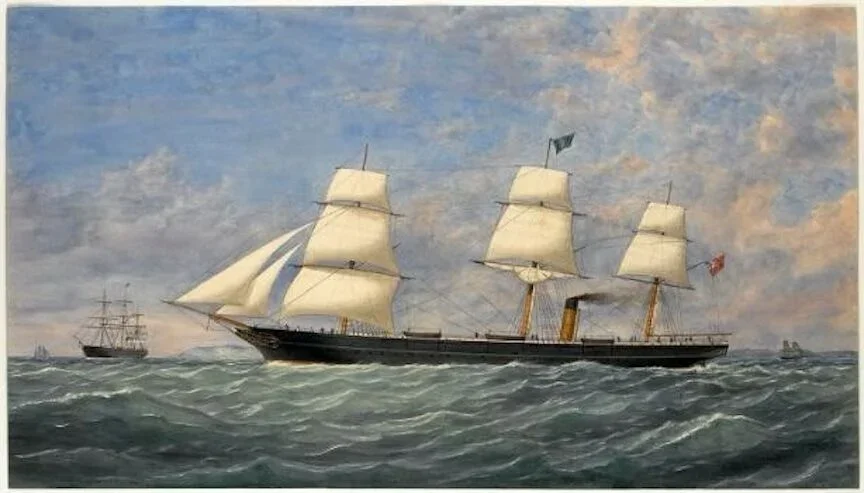
“The Steam Ship Circassian” 1856, unknown artist. National Maritime Museum, Greenwich, London, PAH9015
There have been many tales of shipwrecks. For as long as man has been navigating the Earth’s waters, man has also failed to do so flawlessly. All around the world there are shipwrecks, each with their own unique story. Our own Long Island happens to have a concentration of them in its surrounding waters. Nay, out of the three historical articles I have written thus far, two involve shipwrecks. The first is my column from last month, which focused on HMS Culloden; the second is this month’s installment, “The Peril of the Circassian.”
November 6, 1876, Just off Liverpool Harbor, England
The Circassian has just left Liverpool, bound for New York City’s bustling port with 1,400 tons of cargo, all of it insured for $90,000. In today’s economy that is roughly $2.81 million.
The Circassian has just left Liverpool, bound for New York City’s bustling port with 1,400 tons of cargo, all of it insured for $90,000. In today’s economy that is roughly $2.81 million.
Built in 1856, this vessel was originally an iron-hulled twin-screw steamer and served as a blockade runner for the Confederacy during the Civil War. Her capture by the Federal Navy on May 4, 1862, is known as one of the most valuable captures of the Civil War. After the war, she was auctioned off and refitted for commercial use. For the Circassian, this meant her engines were stripped (allowing for more storage capacity) and she was converted to an all-wind-powered sailing vessel. This is her first transatlantic crossing since her refitting.
December 11th, 1876, Just off Montauk Point, United States
After about a month of sailing, the Circassian finally reaches the eastern tip of Long Island. The bad news: She is being mercilessly battered by a severe winter storm. Having encountered the storm earlier on their trip, the crew is thoroughly occupied with merely keeping the vessel afloat. To make matters more complicated, earlier on their trip, they had come across a foundering Heath Park 500 miles off Montauk Point. Amidst the storm, the crew of 11 had been promptly rescued and brought aboard. With the howling winds and turbulent seas, I have little doubt the crew and their new companions sorely yearned for those engines that had been removed prior to the crossing.
Eventually the storm passes but the Circassian now finds herself in more trouble. By “an error in compass,” she strikes an outer sandbar and is stranded not 400 yards from shore. Luckily, she is only 20 yards west of Mecox Lifesaving Station (then located at the end of Ocean Road in Bridgehampton), perhaps her only stroke of luck in the whole ordeal.
From the Journal of the Mecox Lifesaving Station
Monday, December 11, 1876
This day came in with cloudy weather and light westerly winds and small sea. At 10:55 o’clock P. M. Patrolman Samuel H. Howell discovered a vessel on the outer bar, by her firing off rockets and immediately answered the same by Coston patrol signal, and afterward by blue light.
Tuesday, December 12
There were forty-nine persons on board including eleven wrecking crew taken from off an English bark at sea. The ship was bound from Liverpool to New York with general cargo, about half loaded.
Twenty yards west of station and on the outer bar, drawing 19-1/2 feet of water. Cause of wreck, an error in compass. Boat was launched at 10:30 A.M., and arrived at the ship at 11:00 A.M., and returned at 11:30. Made seven trips in all, and broke five oars. The Captain was Robert Wilson of Liverpool, England.
We had at this time, forty-two persons at the station. We used the mortar and one shot which landed upon the ship’s deck, — made immediate connections by hand line and hawser. In the meantime the tide had fallen off so that we could use the boat as stated above, and filled the boat but once during the day.
The lifesaving station completes its task of rescuing everyone on board, a testament to their bravery and skill. With all 49 people rescued, the next and final task is to rescue the ship itself and the cargo insured for $90,000 ($2.81 million).
Less than half of the crew (14 men plus the stowaway) stay to help salvage the ship.
A plan commences when Captain John Lewis of the Coastal Wrecking Company is tasked with commanding an operation to lighten the Circassian’s load and, in doing so, ease her off the sandbar and into deeper water. With only 15 men from the vessel plus the company’s own men, the operation requires more recruits. Because of this, Shinnecock men from Southampton are enlisted in the salvage operation due to their maritime skills and extensive knowledge of the local waters.
By Christmas Eve, around a third of the Circassian’s cargo has been removed, but with two-thirds still remaining, on December 29th, another winter storm blows in. This one is even worse than the first. The laborers are ordered to stay onboard; there is a possibility this is done at gunpoint.
Friday, December 29th
At 7:00 P.M. E. Erastus Halsey discovered and reported what he thought was a signal of distress from the ship “Circassian” … We at once proceeded to get the gear in readiness to rescue the persons on board. At 8:00 P.M. everything was in readiness … The wind suddenly chops around to the southwest with rain and blowing heavily, which brought everything to the leeward …
… We were obliged to take position full fifty yards back, or close under the sand hill, on account of the extreme heavy sea and full tide … the mainmast fell by the force of the storm, the sea constantly breaking over her. We could see with the glasses of the station the men in the rigging, but about midnight the tide fell off, and we saw the lights on her decks and the ship still whole, but her decks completely swept fore and aft.
Saturday, December 30
This day comes in with heavy westerly gales, cloudy weather and heavy seas running. At, or about 2:00 A.M., discovered that the men on board the ship had again been obliged to take to the rigging, the sea again breaking over her. At 3-1/2 o’clock or thereabouts, discovered that she had broken in two, the forepart settling down, head foremost, and the aft part, stern foremost, the mizzen still erect and rigging full of men … about 4-1/2 P.M. [the mizzen] settled in the water. Soon thereafter, four men were hauled out of the surf, being all that are saved out of thirty-two persons on board.
With the Circassian finally destroyed, only four of the men onboard survive. Three are of the original transatlantic crew, and one is of the later wrecking crew. None of the 10 Shinnecock men who remained aboard for the final salvage operation survived.
Sitting here relaying this history, I cannot imagine how horrific it must have been for those onboard the Circassian during her last moments. Conversely, those ashore must have been haunted for the rest of their lives from powerlessly watching this tragedy unfold.
The peril of the Circassian is still remembered by some as one of the most tragic maritime stories of our area. In addition to having a tragic end, the Circassian has an incredibly odd coincidence associated with it that not many people have chronicled. What happened to the Circassian (a boat which has a relatively uncommon name) had more or less been spelled out 40 years before the ship even sank. During my research for this article, I came across a maritime adventure novel published in 1836 titled, “The Pirate, and The Three Cutters” by Captain Frederick Marryat.
The first half of the book tells the story of a ship called the Circassian. In the book, the Circassian is a cargo vessel sailing from New York Harbor to Liverpool, England. Unfortunately, though, along the way, the ship sinks due to a violent storm out at sea and only three onboard survive. For me (as I hope for you, dear reader), this coincidence brings an air of eeriness to the whole ordeal. See you next month.
To read the article on 27east.com, click here
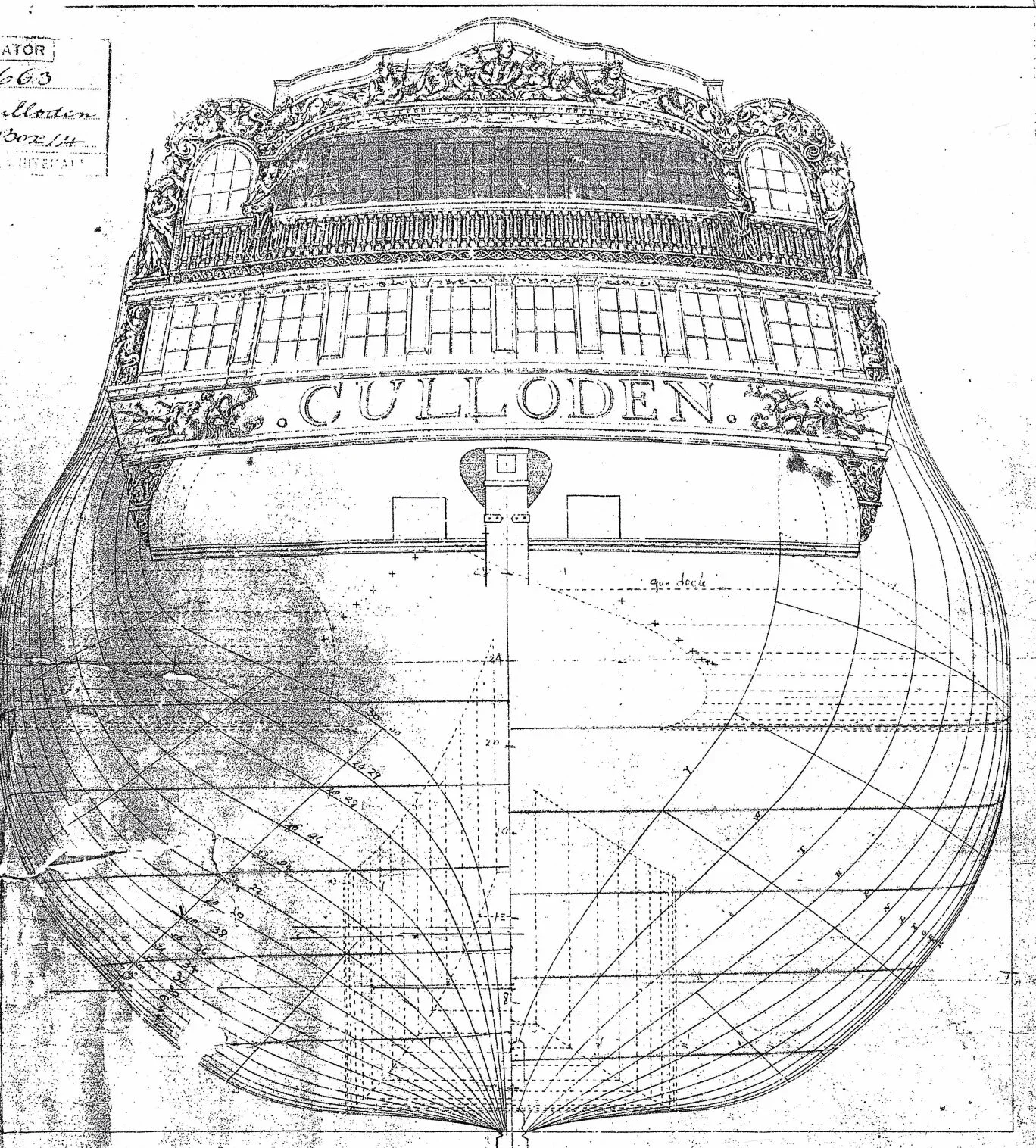
A diagram of the hull of the HMS Culloden found at the East Hampton Library Archives. Courtesy of the East Hampton Library, Long Island Collection.
HMS Culloden (1776), ship plan, after May 1776. © Crown copyright. National Maritime Museum, Greenwich, London. Collection ID ZAZ0978.
Shipwrecks and Rebels on Revolutionary Long Island:
Two East End stories of resistance and resilience during the American War of Independence
by Finny Dianora-Brøndal
August 16, 2026
Long Island is well remembered as the area occupied continuously by the British in the 13 colonies for the longest period during the Revolutionary War. The British took control of the island after the Battle of Brooklyn on August 27, 1776, and held it until their all-out military evacuation seven years later in November 1783. Though history remembers this area as a redcoat stronghold, Long Islanders were deeply divided over the British, as exemplified in my article last month covering Meigs Raid.
With its well-established year-round ports, the city of New York served as an excellent locus for the British navy to facilitate control of both the northern and southern colonies. Indeed, because of this, the waters around Long Island, both the bay and the sound, experienced an increased British naval presence after the Redcoats took control of the island.
One of these vessels was the HMS Culloden. Designed to carry up to 74 guns and hold 650 men, the Culloden was a formidable ship. In her years of service, she had been off Cape Finisterre, Spain, tasked with attacking enemy ships carrying supplies to the Americans; the British coast, where she was assigned to destroy any merchant vessels trading with France; Gibraltar, for various maritime exploits; and the Caribbean. By September 1780, the Culloden was one of 14 warships instructed to merge with a small British fleet stationed in Gardiners Bay. This would end up being her final voyage.
The ship, along with three others, was specifically charged with patrolling an area off Montauk Point roughly 100 miles long which ended at the Nantucket Shoals. Their task was to prevent any French vessels from entering this area by essentially forming a blockade.
Their effectiveness was tested in January 1781, when the British got word that three French warships, which were part of a larger fleet known to be anchored at Newport, were preparing to run the blockade by heading south. The ships Culloden, America and Bedford were the three tasked with capturing them. In haste, they set sail toward Newport to intercept the runners.
On the third day of their search, a severe winter storm hit the squadron with biting winter winds and turbulent seas. In the midst of the chaos, the battered ships lost their way desperately fighting the storm. The America ended up being blown far south, while the Bedford was forced to Long Island shores, managing to drop anchor before being battered into the rocky shoreline by the icy waves. She was dismasted in the process.
The Culloden, however, fared the worst out of the three. As it was trying to reach safety, land and dangerous breakers were sighted and the crew, not able to do anything else, dropped anchors in an attempt to save the ship. The anchors failed and the ship struck bottom, ending its maritime career. At daybreak, the crew found themselves at Will’s Point, off the northern coast of Montauk. They realized that amid the violence of the previous night, the wind and currents had been strong enough to drive their ship astern, undoing their forward progress and driving them to where they now lay.
After failed attempts to free the Culloden from her resting place, she was extensively stripped of all valuables over the next few weeks and eventually ordered to be burned to prevent enemy salvaging. The ship’s captain, Balfour, was later tried in a court-martial proceeding but was honorably acquitted.
The three French runners the Culloden had initially been pursuing had turned back to Rhode Island before the storm could reach them; it is possible this initial attempt to run the line was but a ruse to lure the British into the winter storm. The runners succeeded in their second attempt shortly after, leaving Rhode Island and sailing down to Virginia. Will’s Point was eventually renamed Culloden Point after the war, and it retains the name to this day. You can still visit the shipwreck in Montauk; it lies in 15 feet of water and is a popular diving destination for tourists and locals alike.
There are so many stories from the East End, the shipwreck of the Culloden being one of them. Unlike in my column last month, this time I want to relate more than one story. I humbly ask you to imagine a tenacious 18th-century dissident. He is a man who has had enough. I must note that the following yarn comes from a generational oral tradition which rarely fails to embellish and often omits citations; thus, it should not be treated as embellishment-free.
Isaac Van Scoy was the first in his family to settle in East Hampton. Born c. 1732, he was raised by his grandfather, and this may have played a part in his independent nature. He married a woman in 1757 by the name of Mercy Edwards and shortly after ventured into the dense forests of what is now Northwest Harbor to carve out a home for himself. In quick time, he cleared a portion of land and built a handsome home for himself and his wife. Over the years, it became clear he had built a prosperous life for Mercy and their 15 children, though only eight survived into adulthood. Van Scoy had been illiterate at the time of his marriage but learned quickly to read, a testament to his resolute nature.
When Mercy died in 1782, Van Scoy remarried a widow from a large family herself. He lived to the ripe old age of 82. To put that into perspective, historians estimate that only a small percentage of the total population lived past the age of 80 in this time period.
During the war, the British often raided people’s homes for goods and supplies. Van Scoy wasn’t an exception. One night, a band of raiders demanded he hand over a large sum of money they had gotten wind of. Upon refusal, they threatened Van Scoy. Having none of it, Van Scoy grabbed a sharpened two-pronged pitchfork he kept for protection and attacked them. He managed to kill one and wound two others. He was eventually overpowered and taken to a prison ship lying in Sag Harbor to await his trial. Sometime later, his friends rowed out under the cover of darkness to the ship and managed to break him out via a porthole.
The sheer brazenness of Isaac Van Scoy’s temperament and lifestyle humbles and inspires me. As with the HMS Culloden, this is a story of perseverance. The men and women of the American Revolution period created their own reality. They had great trials ahead of them, yet they continued on in the face of it all. It is a position I find us in again 250 years later.
To read the article on 27east.com, click here.
Finny Dianora-Brøndal is the Sag Harbor Whaling & Historical Museum’s Local History Writing Program intern and a recipient of the Robert David Lion Gardiner Foundation’s 2026 Gardiner Young Scholars Program award. The Whaling Museum’s Local History Writing Program is a new collaborative initiative with The Express News Group that engages students in the exploration, research and documentation of local history.

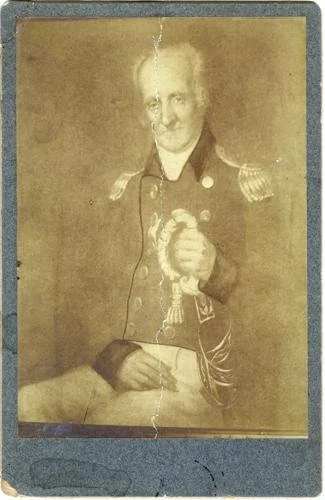
The cabinet card featuring a painting of Lt. Colonel Return Jonathan Meigs was given to the author by his Sag Harbor Relatives. The card has been donated to the John Jermain Memorial Library Archives. Courtesy of John Jermain Memorial Library.
When The Revolution Came to Sag Harbor:
The tale of Meigs Raid reveals how a small village became the site of a big wartime victory
by Finny Dianora-Brøndal
June 26, 2026
About a month ago, I received a photograph (more accurately a cabinet card) from relatives who used to live next door. The photo on the card is of a painting of a colonel. He was an extraordinary man who once headed a daring mission in Sag Harbor during the Revolutionary War.
The card was originally found by my relatives in the 1940s and most likely dates back to the 1890s. At the time of this writing, the United States’ 250th anniversary is only several weeks away; it therefore feels appropriate, and rather important, to tell the story of this colonel and how he was a part of one of Sag Harbor’s most intriguing tales.
Occurring in 1777, Meigs Raid, also known as The Battle of Sag Harbor, is named after Lt. Colonel Return Jonathan Meigs, a veteran of Bunker Hill and the Battle of Quebec, where he served as a major under Colonel Benedict Arnold. After being captured, he was held for six months by the British before being paroled in 1776. Though this raid is named after Colonel Meigs, if it weren’t for the guidance of a lieutenant by the name of Elnathan Jennings, I might not be here now chronicling this story.
Jennings was born in Southampton Township in 1754. In 1776, Jennings’s family, along with other separatists, fled to Connecticut after the British invasion of Long Island and New York. Those who stayed on the East End were forced to house, feed the British and endure their plundering. In April 1777, Jennings enlisted for three years as a sergeant in the Continental Army and was stationed at New Haven.
Around this time, to retaliate for the burning of Danbury, Connecticut and its aftermath, General Samuel Holden Parsons, who had been given independent command in New Haven, was formulating a plan to surprise the enemy’s troops by making a well-planned attack, destroying their supplies, and getting a footing in the effort to take back Long Island. He discussed his plan with Meigs who by then was a colonel in the Sixth Regiment of the Connecticut Line.
Analogous to our modern Special Forces, Parsons and Meigs selected the best-skilled men from various regiments in Connecticut to use for their mission. One of these men appears to have been Jennings.
He writes: “The twentyfourth [sic] of May, 1777, I … volunteered myself to Colonel Meigs, stating the situation of Sag Harbor and the strength of the British guard and how easy they might be taken, and that I would pilot him and a detachment of troops across the sound to Long Island and carry our boats across Oysterpond Branch, about 150 yards, into Southold Bay. Then we could land and come on the back of the guard.”
According to Jennings this was very well received, so much so that according to his account, it appears to have eventually gotten to General Washington who requested an audience with Jennings along with Meigs.
“Then the general sent for me to come to headquarters with Colonel Meigs. Then, after asking me many questions, he was highly pleased with my conversation and plan.”
It is necessary to note that Jennings’s account of the raid and the weeks leading up to it was written many years after the raid itself during the pension era when one might confuse events or be tempted to make embellishments. I mention this because there are no records or other accounts of Jennings meeting with Washington.
The plan was put into effect on May 21st, 1777 (note Jennings’s earlier quote with an incorrect date contradicting the timeline) when the detachment left New Haven in 13 whaleboats. The party consisted of 234 armed separatists with Meigs as their leader and Jennings as their guide. Their first stop was Guilford, Connecticut where they would then make their journey to Long Island under the protection of two armed sloops plus a third unarmed vessel to transport prisoners. Once at Guilford, the party endured a two-day wait due to adverse weather.
On May 23rd, at around 1 p.m., Meigs departed with 170 men in the whaleboats and a flotilla of the three aforementioned sloops. At around 7 p.m., they reached the North Fork of Long Island, where they most likely landed at Hashamomuck Beach in Southold. They then portaged 11 of the 13 whaleboats across the narrow neck of beach into the Peconic Bay. The remaining two whaleboats and three sloops, along with 40 men to help row back, were all fairly exposed to the enemy as they waited for Meigs’s return. Once Meigs and his men arrived at the southern end of the North Fork they rowed out into the Peconic Bay and passed Paradise Point, heading in the general direction of Sag Harbor.
According to a letter that Parsons sent to Washington after the raid, they landed “at about 12 oClock arived Safe across the Bay within about 4 Miles of the Harbour, Where having secured The Boats in the wood under the Care of a Guard: Coln. Meig’s formd His Remaining little Detachment… and at 2 oClock [May, 24th] arrivd at the Harbour.”
This contradicts Jennings’s account which clearly states, “[we] crossed bay, landed just before daylight on Joseph’s Island [likely Jessup Neck], and carried our boats into a thicket of red cedars. There lay all day. The next night, I conducted the boats within about two miles and a half of Sag Harbor … After landed, we left a few men to keep our boats afloat.”
Another first-hand account from a soldier by the name of Christopher Vail states an entirely different spin on the events. It is because of these differing accounts that it is difficult to determine what exactly happened. For the sake of straightforwardness, I will follow Parsons’s official timeline sent to General Washington after the raid due to the potential invalidity of Jennings’s account.
After landing, Meigs and his men took a guardhouse on Brick Kiln Road silently by bayonet. There, the captives gave up the location of the Loyalist Commander of the Port, Captain James Raymond who was staying at Howells Inn (today The American Hotel) which was being used as barracks for the redcoats. When the Americans arrived at Howells Inn, they arrested Captain Raymond and took him prisoner along with the rest of the British staying there.
Following the plan, the Americans attacked the rear entrance of the British Fort which was where the Old Burying Ground is today next to the Old Whalers’ Church on Union Street. They killed six British men and took the remaining 53 as prisoners. As they marched to Long Wharf, they came under fire from a British schooner equipped with 12 guns and manned by 70 determined British.
Despite this, they accomplished their task of setting fire to 12 British anchored brigs and sloops. In addition to destroying several million dollars worth of British vessels in today’s money, Meigs’s crew also took more prisoners at the wharf and captured various supplies such as grain and rum. Not one American was hit. Successful in their mission, the Americans headed back to their whaleboats and rowed back to Connecticut.
General Washington was so impressed when news of the raid reached him that he sent a letter to General Parsons congratulating him on the mission’s success. Additionally, Congress voted to present Colonel Meigs with an honorary sword for his effort in the event.
The legacy of Meigs Raid is that of a success story; it is today considered one of the most successful exploits by the Americans during the Revolutionary War. Looking back on these events, I can hardly believe such a daring plan ever came to fruition in Sag Harbor or that this small village could be at the forefront of our fight for Independence.
To read the article on 27east.com, click here.
Finny Dianora-Brøndal is the Sag Harbor Whaling & Historical Museum’s Local History Writing Program intern and a recipient of the Robert David Lion Gardiner Foundation’s 2026 Gardiner Young Scholars Program award. The Whaling Museum’s Local History Writing Program is a new collaborative initiative with The Express News Group that engages students in the exploration, research and documentation of local history.